How to limit the risk of vibrations during the transport of works of art
Identifying vibration risks is just the beginning. For heritage institutions, the challenge lies in transforming this knowledge into operational decisions: adapting crates, choosing the right vehicle, organizing handling, instrumenting the most sensitive transports, and leveraging the data over time.
From this perspective, mechanical engineering and monitoring provide valuable tools to make conservation more personalized and predictive.
1. Moving from intuition to data
For a long time, loan and transport decisions relied mainly on experience, empirical feedback, and best practices. For certain fragile or iconic works, this approach is no longer sufficient: it is becoming necessary to have measured data that can be reused from one project to another.
A data-driven approach allows you to:
- objectify the risk for each work;
- document decisions for management, scientific committees, insurers, and authorities;
- capitalize on experience: each instrumented transport enriches the knowledge of the mechanical behaviors of the works.
2. Assessing risk before transport
2.1. Diagnosis of the work
Before any movement, a thorough examination of the work constitutes the basis for the decision:
- detailed condition report (support, paint layer, varnish, fixings, restorations);
- identification of highly sensitive zones (cracks, lifting, unstable elements, fragile old restorations);
- classification of the work according to its presumed sensitivity to vibrations (low, medium, high).
Based on this diagnosis, several options can be envisaged:
- transport possible with a slightly adapted standard crate;
- transport conditional on a specific crate, a reinforced damping system, and/or monitoring;
- deferred or refused transport, if the mechanical risk is deemed too high regarding the work’s current state.
2.2. Analysis of the route and logistical context
In parallel, analyzing the transport context is essential:
- total distance, duration, and type of roads (highway, secondary roads, urban areas, cobblestones);
- number and nature of vector changes (truck, loading dock, freight elevator, trolley, etc.);
- schedule constraints, installation windows, co-activity on site;
- presence of critical zones (slopes, thresholds, stairs, construction sites, diversions).
This analysis makes it possible to anticipate the segments potentially most stressful for the work.
3. Designing an adapted crate and damping system
3.1. Transport crate
The crate is the first level of mechanical and climatic protection:
- rigid, stable crate, with a structure sized around the work
- integration of thermal and hygrometric insulation elements according to the duration and context of transport
- design of holding and cushioning points defined with conservation-restoration, relying on mechanical knowledge of the support.
3.2. Mechanical damping
Between the work (or its support) and the crate, the role of damping materials is crucial:
- foams selected for their mechanical behavior (density, thickness, viscoelasticity)
- damping interfaces (pads, spring systems, high-damping materials)
- vibration isolation solutions aiming to filter potentially damaging frequencies.
Two extremes are to be avoided:
- cushioning that is too rigid, which transmits almost all shocks and vibrations to the work
- cushioning that is too loose, which allows the work to gain momentum inside the crate.
The goal is to reach a mechanical compromise: hold the work firmly, while leaving the system the capacity to dissipate energy.
4. Choosing the right carrier, vehicle, and route
4.1. Specialized Carrier
The choice of carrier conditions a large part of the risk:
- use carriers specialized in works of art, familiar with preventive conservation constraints
- verify the existence of written driving and handling procedures
- involve the carrier in the upstream reflection on the specific constraints of the work.
4.2. Vehicle and driving
A few points of attention:
- selection of adapted vehicles (suspensions, crate holding systems, climate control if necessary)
- sensitization of drivers to smooth driving (progressive acceleration, anticipated braking, adapted speed)
- limitation of transfers from one vehicle to another, as each handling operation is a potential source of shocks.
4.3. Route
The route can be optimized with a risk reduction logic:
- prioritize the smoothest and most regular axes, even if the trip is slightly longer
- avoid, as much as possible, cobblestone roads, heavily degraded roads, or those with a succession of speed bumps
- anticipate construction zones and diversions that could impose unfavorable conditions.
5. Organize Handling and On-Site Procedures
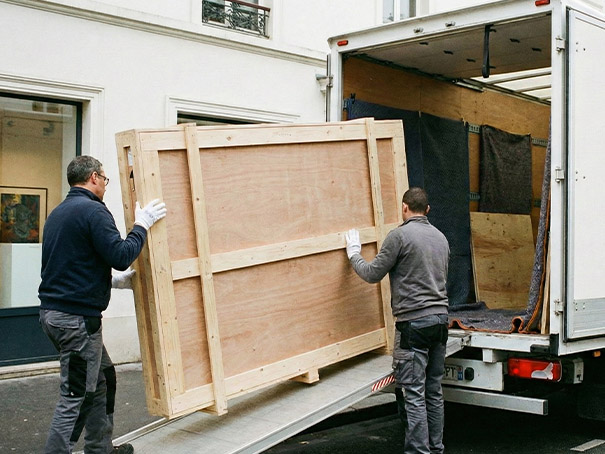
Many of the most intense stresses occur during handling, sometimes over just a few meters:
- Limit the number of transshipments (truck → loading dock → freight elevator → forklift → room)
- Systematically use tail lifts, ramps, and gantries to overcome differences in level
- Prohibit stepping over stairs with heavy or bulky crates
- Write simple and clear procedures, shared with all stakeholders
- Organize operations to avoid rushed situations (delays, reduced staff, unanticipated concurrent activities).
6. Implement Appropriate Monitoring: Sensors and Data
6.1. Which sensors to use?
Depending on the artwork and the level of risk, several configurations are possible:
- Vibration sensors/accelerometers (often tri-axial, X-Y-Z) measuring accelerations along the entire path
- Shock recorders detecting and storing acceleration peaks exceeding a certain threshold
- Multifactorial monitoring systems combining vibration, shock, temperature, relative humidity, and even light.
Sensors can be:
- Integrated into the crate,
- Mounted on a mechanical support attached to the artwork, when possible,
- Located in the immediate vicinity of critical areas, after approval by the conservation department.
6.2. Leveraging Data: Towards Predictive Conservation
The value of monitoring lies not only in having graphs, but also in the ability to interpret them and use them to inform decision-making:
- analysis of vibration levels during transport (average values, peaks, exposure time)
- identification of critical events (shocks, specific road sections, handling phases)
- comparison with internal reference data and research data
- production of transport reports that can be integrated into loan, restoration, or research files.
As projects progress, this data feeds into an increasingly personalized and predictive approach to conservation: each artwork can be tracked over time, throughout its exhibitions and transports.
7. Going Further: From Understanding to Action
Understanding the problem is the first step. The next step involves concretely mitigating risks: designing shock-absorbing crates, selecting the vehicle and route, implementing handling procedures, and installing sensors and monitoring platforms to analyze data over time.