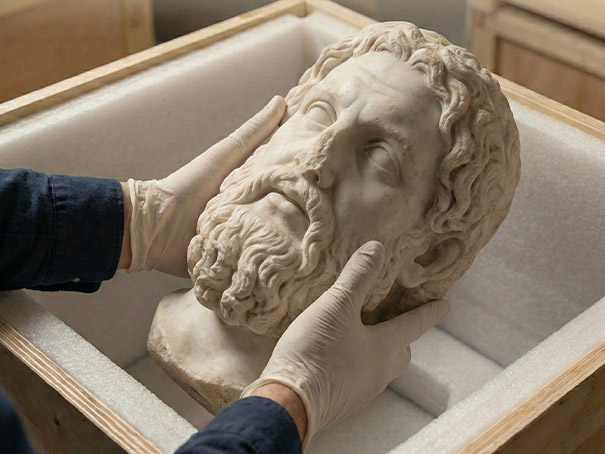
Vibrations and the transport of works of art: understanding the risks
Works of art and masterpieces are increasingly circulating between museums, storage facilities, and exhibition spaces. Temperature, relative humidity, security, and insurance are now standard considerations for transporting works of art. Vibrations, however, often remain in the background, even though they constitute a major risk factor, still poorly documented at the collection level.
For curators, registrars, museum directors, and DRAC (Regional Directorate of Cultural Affairs) curators, understanding what works of art experience during transport is an essential step before implementing protection and monitoring solutions.
1. Why vibrations are a major risk for works of art
Vibrations and shocks associated with transport can:
- cause micro-cracks in paint layers and varnishes;
- accentuate detachment between the paint layer, ground, and support;
- weaken wood joints (panels, frames, sculptures, furniture);
- contribute to mechanical fatigue in aging materials;
- destabilize old or heterogeneous fastening systems (nails, screws, pegs, old glues).
Particularly sensitive are:
- panel paintings with splits, joints, or old restorations;
- large-format paintings on canvas that are loosely tensioned or on weakened stretchers;
- polychrome wood sculptures or composite objects;
- mounted objects, with added elements or cantilevered parts;
- any work already showing cracks, lifting, losses, or extensive restorations.
In these cases, transport is never neutral: it is a matter of quantifying and qualifying the actual risk incurred.
2. Where do vibrations come from during artwork transport?
During a journey, a work does not undergo a single uniform vibration, but a succession of mechanical stresses from various sources:
- Vehicle motion: road condition, potholes, cobblestones, speed bumps, rails, bridge joints, etc.
- Suspension and truck type: unadapted vehicles, inadequate settings, over- or under-loading.
- Handling: crossing thresholds, curbs, ramps, moving on pallet jacks or trolleys, freight elevators.
- Loading/unloading operations: small drops, jolts, sudden rotations, point loads.
Schematically, we distinguish:
- continuous vibrations linked to driving, over a wide frequency range;
- punctual shocks (speed bumps, curbs, sudden braking, impact), capable of causing immediate damage.
For the artwork, what matters is not just the isolated event, but the entire vibrational spectrum to which it is exposed: amplitude, frequencies, duration, repetition, and directions of the stresses.

3. How Vibrations Damage Heritage Materials
The effect of vibrations on a work of art depends on its structure, materials, and history:
- Structure: panel, canvas, sculpture, furniture, composite object, etc.
- Materials: wood, canvas, animal glues, ground layers, binders, fillers, varnishes, composite materials.
- State of conservation: cracks, lifting, old restorations, weakened areas.
- Resonance frequencies: certain parts of the artwork can resonate with external stresses.
Several damage mechanisms can be observed:
- Mechanical fatigue: a large number of cycles, even of low amplitude, can cause progressive breakage, the slow opening of a crack, or the reactivation of a fragile area.
- Friction and micro-slipping: between poorly secured elements or at interfaces (for example, paint layer/ground), generating slow wear and micro-gaps.
- Local amplification by resonance: frames, cantilevered elements, and added parts can vibrate more strongly than the rest of the artwork.
- Reopening of old cracks: cracks stabilized under stationary conditions can reopen under repeated stress.
The actual risk always results from a combination of factors: vibration level, frequencies, exposure time, the object’s intrinsic fragility, and its history of previous transport.
4. Typical Risk Scenarios for Collections
Some situations combine several unfavorable factors:
- Long international road journeys with vehicle changes, sections of highway, followed by degraded secondary roads.
- Transport in a refrigerated truck, where the refrigeration unit adds a level of vibration specific to the system.
- Very fragile artwork (cracked panel, lifting paint, unstable sculpture) entrusted to standard transport, without crate modifications or monitoring.
- Multiple loans over a short period, without cumulative monitoring of mechanical stresses.
- Imposed routes (roadworks, detours) including very degraded roads, cobblestones, or roads with numerous speed bumps.
In these situations, relying solely on intuitive criteria (“it’s gone well so far”) is no longer sufficient: the decision to lend, reinforce a security measure, or refuse transport must rely on objective elements.
5. When should a work of art be considered “at risk of vibration”?
Several criteria, often combined, indicate that a work requires special attention regarding vibration:
- Documented fragile state of preservation (cracks, lifting, significant restorations);
- Structural complexity (composite object, added elements, cantilevered areas);
- History of damage or warnings during previous transports;
- Complex route and logistics (long distance, poor road conditions, numerous changes of transport, tight scheduling constraints).
Identifying these criteria in advance allows us to:
- Classify works according to their sensitivity to vibration;
- Prioritize protective measures (specialized crate, damping systems, monitoring);
- Better justify decisions to management, partners, and insurance providers.
6. Glossary – Vibrations and the Transport of Works of Art
Amplitude (of vibrations)
Intensity of a vibration or shock. The greater the amplitude, the greater the stresses on the artwork.
Impact (Point)
A brief, high-amplitude stress (fall, impact, sudden collision with an obstacle, hard braking) that can cause immediate damage.
Preventive Conservation
All measures taken to limit the risk of deterioration by modifying the environment of the artwork (climate, light, vibrations, handling, transport).
Paint Layer
All the layers of paint (binder and pigments) and, where applicable, surface varnishes.
Detachment
Loss of adhesion between two layers (for example, paint layer/ground, ground/support).
Mechanical Fatigue
Progressive damage to a Material subjected to repeated stresses, even of low amplitude.
Frequency (of vibration)
Number of vibration cycles per second, expressed in Hertz (Hz).
Microcrack
A very narrow crack, often difficult to detect with the naked eye.
Composite Object
A work of art made up of several materials with different mechanical properties (wood, metal, textiles, adhesives, paint layers, etc.).
Resonance
Amplification of vibrations when the applied frequency corresponds to a natural frequency of the object or one of its parts.
Vibration Spectrum
Distribution of vibrational energy as a function of frequency, useful for identifying dominant frequency bands.
Support
The structure supporting the artwork: wood panel, canvas, metal, paper, etc.
Vibration (Continuous)
Oscillatory movement repeated, generally related to vehicle movement and road surface conditions.
7. Going further: from understanding to action
Understanding the problem is the first step. The next is to concretely limit the risks: designing shock-absorbing crates, choosing the vehicle and route, implementing handling procedures, and setting up sensors and monitoring platforms to analyze data over time.